 By
kingsly jebaraj
By
kingsly jebaraj Native vs Cross Platform development is a choice that will continue for businesses as they feel the growing need to develop mobile apps with speed, quality & user experience. The more companies grow in competition, the greater the decision-making process of which method best fits your needs in terms of cost, maintenance, development time, and performance/scalability.
Regardless if it’s developing a consumer application (a consumer-facing app) or an enterprise mobile application development project, being able to understand the pros/cons of both approaches will enable you to make better decisions when making investments.
What is Native App Development?
Native app development is the practice of creating a native application for a single OS.
Without further ado, developers use platform-specific programming languages, such as:
Native Apps: Built for a single platform, so developers can fully use the device’s hardware and Operating System (OS) resources (for example cameras, GPS, etc.), sensors, Bluetooth, etc., biometric data, etc.
By having this natively integrated function, it delivers a user experience with much faster processing speeds that answers lag times and so on.
Cross-Platform App Development
Developers create one code base that is used in creating an application that runs on multiple platforms. The most popular cross-platform tools/frameworks are listed below
- Flutter
- React Native
- Xamarin
Developers write code once and deploy across platforms rather than building separate apps for iOS and Android. It requires lower development effort and quicker time to delivery and offers reduced costs with almost native performance.
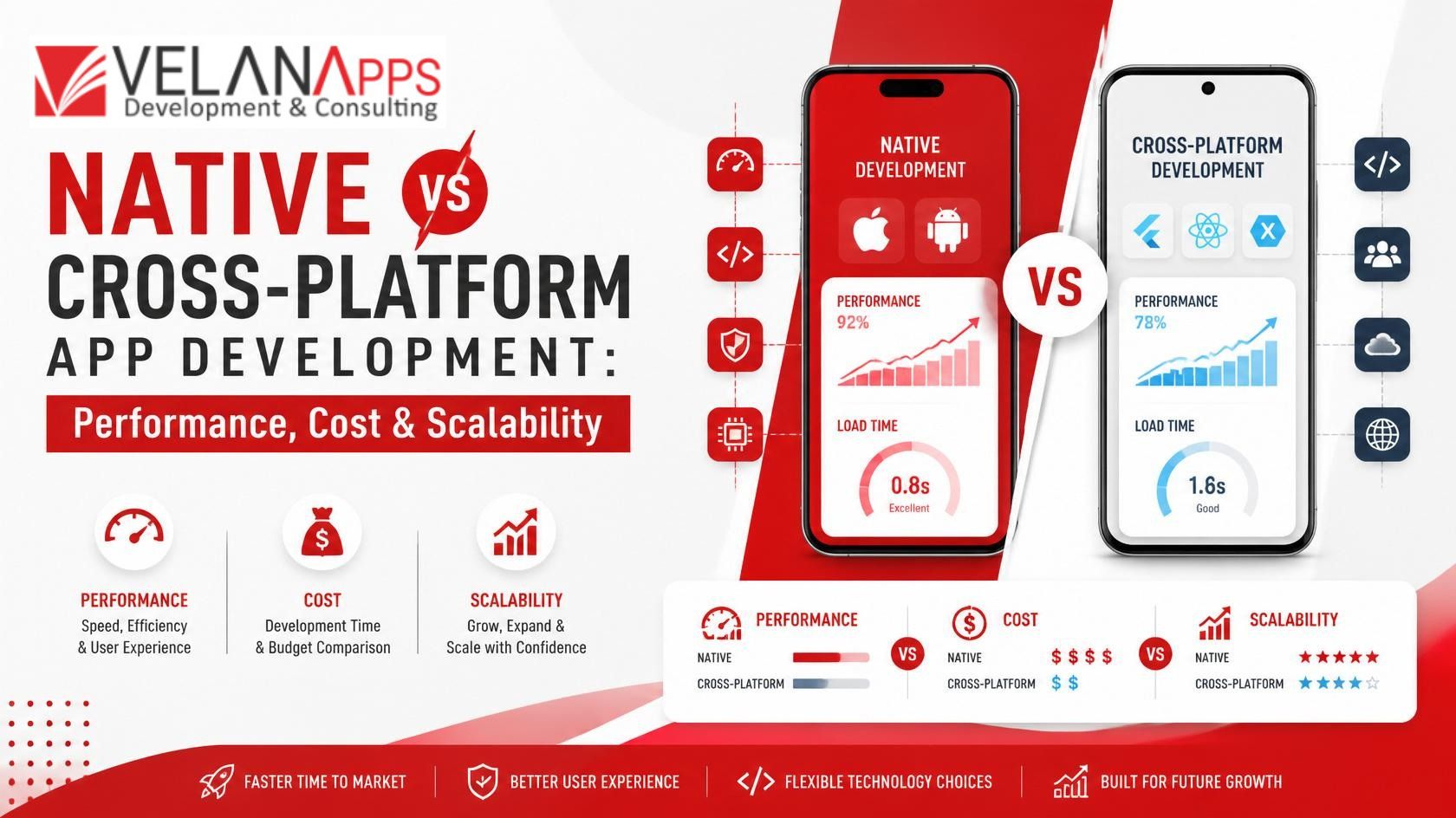
Native vs Cross-Platform: Key Differences
| Feature | Native Apps | Cross-Platform Apps |
| Performance | Best | High |
| Development Speed | Slower | Faster |
| Cost | Higher | Lower |
| UX/UI | Native experience | Near-native |
| Scalability | Excellent | High |
| Maintenance | Complex | Easier |
| Device Access | Full | Limited |
| Security | Strong | Moderate-High |
The mobile app development comparison depicts the trade-off that businesses should put under examination before choosing a development path.
Performance Comparison
Performance is still one of the most debated topics in the native vs cross-platform app development dialogue.
Native apps typically deliver:
- Faster load times
- Smooth animations
- Better responsiveness
- Lower latency
- Superior handling of complex processes
Native apps face reduced performance bottlenecks as they directly interact with the operating system.
Over time, cross-platform frameworks have really evolved. In the discussions of flutter vs native apps, it is indicated that Flutter can reach awesome speeds and smooth interfaces for many business applications.
In a comparable manner, react native vs native debates typically conclude with React Native offering great performance for regular business applications, while any very graphics-heavy apps are likely still better off with native.
The complexity of the application has a big role in evaluating cross-platform vs native performance.
Cost Comparison
Often, the decision between native and cross-platform solutions is a function of your development budget.
Native development generally requires:
- Separate iOS and Android teams
- More development hours
- Higher testing costs
- Additional maintenance resources
This means that native apps generally require a larger initial investment.
If you compare the cost of native app development, usually cross-platform projects from scratch save up to 30% and more (in some cases by 40%) on development expenses.
Cross-platform development lowers costs through:
- Shared codebases
- Faster development cycles
- Reduced maintenance effort
- Simplified updates
Cross-platform development usually gives better value for a short period of time, especially for startups and businesses that have very limited budgets.
Scalability & Enterprise Readiness
Scalability is the ability for more users and applications.
Many consider native applications to be extremely scalable because they utilise optimisations specific to a certain OS as well as hardware modules.
On the other hand, modern cross-platform frameworks make huge strides in enterprise capabilities.
Due to large organisations successfully using React Native for business-critical applications, questions about react native scalability for enterprise apps are becoming more common.
When designed correctly, both approaches can work for long-term growth for many organisations.
If you are working on a large enterprise mobile app development, scalability depends on the architecture and backend infra, which is more independent of the framework.
UX comparison for Customers
The customer experience has a direct relationship with the user experience. Therefore, customer satisfaction and retention are affected by customer experience.
Native apps provide:
- Platform-specific design patterns
- Consistent navigation
- Faster interactions
- Familiar user experiences
This advantage matters particularly for apps that need to be very polished.
Native experience can differ depending upon how you implement the framework. However, most cross-platform frameworks offer users an almost native experience. Flutter and react native enable developers to create beautiful, responsive user interfaces as well as provide seamless functionality across all types of devices.
Security Considerations
Security is an important factor for both consumer and enterprise applications.
One of the strongest advantages native apps have:
- Access platform security features directly
- Receive operating system updates faster
- Support advanced authentication methods
- Enable tighter integration with device security tools
Strong security practices are also supported by cross-platform frameworks, such as:
- Data encryption
- Secure APIs
- Multi-factor authentication
- Role-based access controls
For industries handling sensitive information, security requirements should be carefully evaluated during platform selection.
Top Utilisation Cases for Native Apps
- Gaming applications
- AR/VR experiences
- High-performance financial apps
- Video streaming platforms
- Applications requiring extensive hardware access
Organisations seeking maximum performance and platform optimisation often choose native development.
When Cross-Platform Apps Are Used Most Effectively
Cross-platform development works well for:
- Business applications
- Customer service apps
- Internal enterprise tools
- E-commerce platforms
- Startup products with limited budgets
When firms want to go to market quickly, many prefer cross-platform app development.
Enterprise Mobility Strategy Considerations
An enterprise mobility app strategy will not be effective if it is based on technology preferences; it must work toward the business goals.
Think about:
- Target audience
- Budget limitations
- Goals for time to market
- Security requirements
- Scalability needs
- Maintenance resources
Deciding on the best mobile app framework for enterprise apps is a template balancing these considerations against one’s long-term business vision.
Mobile App Development Trends for the Future
The native vs cross-platform app development rift is closing.
Emerging trends include:
- AI-powered mobile applications
- Improved Flutter performance
- Enhanced React Native architecture
- Platforms for low-code development
- Mobile architectures that are cloud-native
- A greater emphasis on business mobility
FAQs
Do cross-platform apps perform at the same level as Native Apps?
Native applications offer higher performance levels and are usually better for resource-intensive uses, although contemporary tools can still perform quite well.
Is there any cost of building native apps that is less than developing cross-platform apps?
Producing native apps is often more expensive as you need to build separate versions of your application for every platform.
Difference between Flutter and Native development?
Flutter has a number of advantages over native, including speed to market and reduced overall cost. Native development will provide better performance and allow greater access to device hardware.
Can cross-platform apps be scalable?
Yes. The application you are building is large enough, and modern frameworks give us the option to build and manage all aspects of enterprise-level applications across different departments or even projects.
Which app development option is best for enterprise apps?
Each company will need to make their own decision about which option is the best fit for their company based on the specific goals of the project, security requirements needed, the level of performance required, and budget constraints.
What are the disadvantages of native app development?
Cons of Native App Development
Native development typically has higher costs, a longer time to market and the need for separate teams for both iOS and Android.
Conclusion
Whether to develop a mobile application with native or cross-platform tools is based on your company’s objectives for your mobile app project (e.g., cost and budget), as well as your performance expectations. Developing apps natively will provide the highest quality performance and most superior user experience, while developing cross-platform applications will allow you to spend less money on software development and get an advantage in terms of time to market. Your ability to grow your product over the life cycle of that product, maintain it and scale it should also be a factor when determining which option is better suited to meet your needs.