 By
kingsly jebaraj
By
kingsly jebaraj Keeping customer data safe is a legal and competitive requirement now and cannot be optional anymore. For Magento merchants in the USA, Magento GDPR compliance ensures transparency, trust, and data security for customers across global markets. Even though GDPR is an EU regulation, U.S. businesses serving EU customers must follow it to avoid penalties and strengthen their privacy framework. We encourage you to read on to learn how GDPR impacts Magento, key features, extensions, top practices, and finally how stores in the U.S. can achieve full compliance.
What is GDPR and what makes it important for Magento?
GDPR stands for General Data Protection Regulation. It’s a big EU law that basically hands people real control and transparency over their data. If your Magento shop collects info from anyone in the EU—maybe for shipping orders, sending out newsletters, tracking analytics, or letting folks set up user accounts—you need to play by these rules.
Here’s why it matters:
- The penalties for ignoring GDPR are no joke and include fines that can hit €20 million. That’s enough to put a serious dent in any business.
- However, compliance is not just dodging fines. If customers are aware, you respect their privacy, it gives them more confidence in dealing with you. That kind of trust is what builds a brand and brings people back.
- On top of that, GDPR pushes you to get your data management in order—so you’re not just protecting your customers, you’re streamlining your own processes, too.
Magento GDPR Features and Extensions
To meet GDPR and other compliance needs, Magento includes native and third-party tools.
Most of them streamline data management, customer rights, and consent tracking.
Cookie Consent and Data Access Controls
This area is central to Magento privacy requirements. Here’s what you get:
- You can add cookie consent banners, so people actually pick which cookies they’re okay with—maybe just the ones needed to run the site, or things like analytics and marketing cookies.
- There are options to download your own personal data, too. If someone wants their info, they just grab it.
- Want out? Users can ask for their account to be deleted, no hassle.
- There’s also a log that keeps track of exactly when people say yes or no to cookies.
- Role-based permissions make sure only the right staff can see sensitive customer info—no random access.
- Some of the most popular GDPR plugins for Magento are Amasty GDPR, MagePlaza GDPR, Meetanshi GDPR, and Aheadworks GDPR Compliance.
These tools do a lot of the heavy lifting. Magento makes things a bit easier. They help you handle consent, cookies, and those data requests, so following the rules doesn’t feel so overwhelming.
Best Practices for GDPR Compliance
If you need to gather some things, then preferably only the ones you really need! Do not get greedy with personal data.
- Use double opt-in for sign-up or subscriptions. Give users clarity on what they’re agreeing to (e.g., don’t pack your consent forms with a bunch of confusing jargon).
- Provide users a choice of which cookies they are happy with. Provide them the choice to turn off anything that’s not essential.
- Always encrypt customer data, especially payment and address info. Don’t take chances with that.
- Keep Magento itself, plus all your themes and extensions, up to date. Security holes pop up fast, so patch them as soon as you can.
- Write a privacy policy that actually explains what you’re doing with personal data—don’t just bury it in legal jargon.
Map out your data processing so you know exactly what’s happening. That way, if there’s ever an audit, you’re ready.
How to Make Your Magento Store GDPR Compliant in the USA
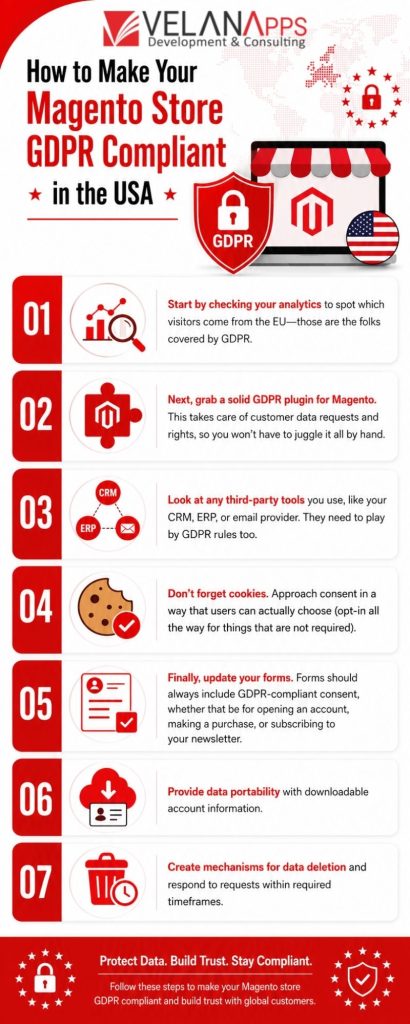
- Start by checking your analytics to spot which visitors come from the EU—those are the folks covered by GDPR.
- Next, grab a solid GDPR plugin for Magento. This takes care of customer data requests and rights, so you won’t have to juggle it all by hand.
- Look at any third-party tools you use, like your CRM, ERP, or email provider. They need to play by GDPR rules too.
- Don’t forget cookies. Approach consent in a way that users can actually choose (opt-in all the way for things that are not required).
- Finally, update your forms. Forms should always include GDPR-compliant consent, whether that be for opening an account, making a purchase, or subscribing to your newsletter.
- Provide data portability with downloadable account information.
- Create mechanisms for data deletion and respond to requests within required timeframes.
Even if you operate primarily in the U.S., compliance protects your business from cross-border issues and enhances customer confidence.
Magento GDPR Compliance Checklist for US Businesses
Here’s what you need to tick off to keep your Magento store on the right side of GDPR:
- Show a cookie banner that follows GDPR rules.
- Get clear consent when people check out, join your newsletter, or fill out contact forms.
- Set up tools that let users see and export their data automatically.
- Make sure people can delete their data if they ask.
- Keep your privacy policy and terms pages up to date.
- Store customer data securely and make sure it’s encrypted.
- Install a dedicated GDPR plugin.
- Keep logs of every user consent and privacy-related action.
- Check all your third-party providers for GDPR compliance.
- Train your admins on GDPR and data protection basics.
Common Mistakes to Avoid in GDPR Implementation
Even with good intentions, it’s easy for merchants to slip up on GDPR. What trips people up most is this:
- Having default cookie banners and not customizing them to fit your store
- Skipping consent checkboxes on forms and checkout pages
- Not complying when customers request you to delete or send them their data
- Asking for more information from the customer than you require, such as redundant phone numbers or unnecessary address data
- Having your privacy policy fall out of date, such that it no longer reflects how you are actually processing data
- Malicious Extensions or data-leaking extensions, exploit useful but buggy extensions that run on a browser and do not process the data they receive safely.
We’ve covered a lot of ground, and keeping on top of these will help to minimize compliance risks whilst also securing your store.
Final Thought—Ensure Compliance and Security with Magento
The importance here lies in establishing trust between you and your consumer and demonstrating that you value their privacy. If US Magento store owners have the right tools along with the right privacy habits, we can all achieve GDPR level standards and make shopping much safer for all of us. Protect user data now, and your brand will keep its good name—and stay compliant—for the long haul.
FAQs
1. Is Magento GDPR compliant by default?
Magento provides some built-in privacy features, but it is not fully GDPR compliant out of the box. Most businesses need additional configurations or GDPR extensions to effectively manage cookie consent, customer data requests, and privacy preferences.
2. Which Magento GDPR extension is best for my online store?
Popular Magento GDPR extensions include Amasty, MagePlaza, Aheadworks, and Meetanshi. The right extension depends on your business requirements, Magento version, and compliance needs. Professional implementation ensures the extension works correctly with your store.
3. Does GDPR apply to US-based Magento stores?
Yes. If your Magento store collects or processes personal data from customers located in the European Union, GDPR applies regardless of where your business operates.
4. How often should a Magento store undergo security audits?
A Magento store should be audited regularly, especially after major updates, new extension installations, or infrastructure changes. Periodic security assessments help identify vulnerabilities before attackers can exploit them.
5. Can VelanApps help implement GDPR compliance for Magento stores?
Yes. VelanApps helps businesses build and maintain GDPR-ready Magento stores by implementing privacy-focused features, integrating GDPR extensions, optimizing security, and ensuring your eCommerce platform follows industry best practices. For advanced cybersecurity, compliance assessments, and data protection services, businesses can also leverage VelanInfo‘s security expertise.