 By
kingsly jebaraj
By
kingsly jebaraj Mobile applications are now an important tool for businesses, but they expose companies to rising cyberattacks. Other attacks may include malware as well as poor authentication and encryption methods that allow hackers to steal customer data and interfere with your operation.
These risks are never-ending, and companies require powerful mobile app security to render their development easier. Today, we share the OWASP Mobile Security Framework, which assists organisations in detecting common vulnerabilities and creating more secure mobile applications. This guide highlights some of the greatest OWASP risks and how you can best mitigate against them.
Mobile App Security for Enterprises
While employees and customers are already dependent on mobile apps to access business services, pay or receive payments, manage personal information management, etc. That naturally makes them a target for cyberattacks.
A weak mobile application security can lead to the following:
- Data breaches
- Financial losses
- Regulatory penalties
- Business disruptions
- Loss of customer trust
- Loss of brand image
Therefore, first and foremost, to reduce these risks, companies need to focus on security in the development of mobile apps as well as on securing the whole application lifecycle through strong security measures.
Understanding OWASP Mobile Top Risks
The OWASP Mobile Top 10 outlines the most prevalent mobile vulnerabilities and guides businesses on how to enhance their security posture.
| OWASP Risk | Description |
| Improper Credential Usage | Weak login methods can allow attackers to access user accounts. |
| Insecure Data Storage | Sensitive information stored on devices may be exposed. |
| Insecure Communication | Unprotected data transfers can be intercepted by attackers. |
| Insufficient Cryptography | Weak encryption may fail to protect important data. |
| Insecure Authentication | Poor authentication controls can lead to unauthorized access. |
| Code Tampering | Attackers may modify or reverse engineer app code. |
| Security Misconfiguration | Incorrect settings can create security vulnerabilities. |
By following OWASP mobile security recommendations, organisations can lower these risks.
Common Enterprise Mobile Security Threats
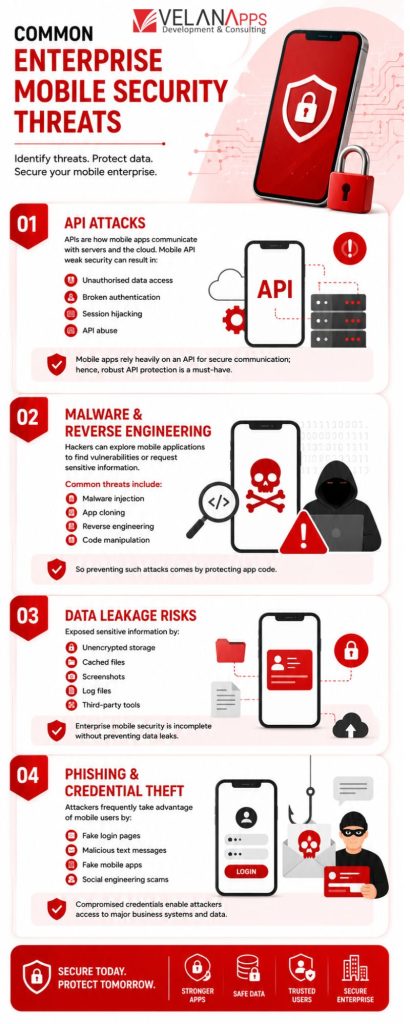
API Attacks
APIs are how mobile apps communicate with servers and the cloud. Mobile API weak security can result in:
- Unauthorised data access
- Broken authentication
- Session hijacking
- API abuse
Mobile apps rely heavily on an API for secure communication; hence, robust API protection is a must-have.
Malware & Reverse Engineering
Hackers can explore mobile applications to find vulnerabilities or request sensitive information.
Common threats include:
- Malware injection
- App cloning
- Reverse engineering
- Code manipulation
So preventing such attacks comes by protecting app code.
Data Leakage Risks
Exposed sensitive information by:
- Unencrypted storage
- Cached files
- Screenshots
- Log files
- Third-party tools
Enterprise mobile security is incomplete without preventing data leaks.
Phishing & Credential Theft
Attackers frequently take advantage of mobile users by:
- Fake login pages
- Malicious text messages
- Fake mobile apps
- Social engineering scams
Compromised credentials enable attackers access to major business systems and data.
Secure Authentication Strategies
Authentication is an important way for organisations to confirm a user’s identity and ensure they have permission to use your application.
Some ways you can create a safe, secure method for authenticating your users through mobile applications include using
- Multi-factor authentication
- Creating strong password requirements
- Adaptive authentication
- Single sign-on
- Token-based authentication
- Session timeout controls
Multi-factor authentication is a deeper level of protection than passwords alone.
Biometric Authentication in Mobile Apps
However, due to recent developments in biometric authentication technology and the use of mobile apps for secure access to various services, many organisations have settled on a few simple solutions.
Common biometric methods include:
- Fingerprint scanning
- Facial recognition
- Iris recognition
- Voice authentication
Benefits include:
- Faster login experiences
- Less reliance on passwords
- Better identity verification
- Lower risk of credential theft
Biometric information should always be stored securely and encrypted.
Mobile API Security Best Practices
Good security for a mobile application programming interface will guard both the backend system and user credentials.
Mobile API Authentication Best Practices
Organizations should:
- Use OAuth 2.0 authentication.
- Deploy API gateways
- Apply rate limiting
- Validate user inputs
- Use short-lived access tokens.
- Monitor API activity
- HTTPS and TLS encryption → Protects API communication
Mobile App Encryption Best Practices
Encryption is the process of concealing sensitive information from unauthorised access.
Best practices include:
- Encrypting stored data
- Encrypting transmitted data
- Using strong encryption standards
- Managing encryption keys securely
- Avoiding hardcoded keys
Security is maintained with regular updates to the encryption methods.
Mobile Testing and Security Audits
Get to know about mobile penetration testing before attackers find out about it.
Testing often examines:
- Authentication systems
- Data storage
- APIs
- Network communications
- App code
- Security configurations
Benefits include:
- Finding vulnerabilities early
- Reducing security risks
- Improving compliance
- Strengthening app security
You should do regular testing when the development is going on.
Mobile App GDPR & HIPAA Compliance
In addition to protection, enterprise mobile security should cover compliance aspects as well.
GDPR Compliance for Mobile Apps
Any company processing data about users in Europe needs to comply with one or more of the following GDPR rules:
- User consent management
- Data minimisation
- Data access rights
- Data deletion rights
- Breach notification procedures
Otherwise, you could be looking at not only your legal penalties but also hefty fines.
HIPAA-Compliant Mobile App Development
HIPAA goes beyond that, as healthcare apps processing patient data will have to comply with HIPAA.
Important requirements include:
- Data encryption
- Access controls
- Audit logs
- Secure data transmission
- User authentication
There are several measures that protect sensitive healthcare data.
Zero Trust Architecture for Enterprise Mobile Apps
Many businesses are adopting zero-trust architecture for mobile apps to improve security.
The core principle is the following:
Never trust, always verify.
Key elements include the following:
- Continuous authentication
- Device verification
- Least-privilege access
- Risk-based access controls
- Real-time monitoring
Instead of automatically trusting users or devices, every access request is verified before access is granted.
Security Best Practices for Enterprise Mobile Apps
Organisations can strengthen enterprise mobile app security best practices by following these recommendations:
- Integrate security in the development lifecycle
- Regular code reviews
- Vulnerability assessments
- Mobile device management (MDM)
- Enforce strong authentication controls
- Secure APIs and backend systems
- Encrypt sensitive data
- Monitor application activity continuously
- Perform regular security testing
Mobile App Security: Future Trends
Emerging technologies and the changes of the threat arena will be factors in determining the mobile app security that we will have in the future.
Some of the most significant changes are:
- AI-powered threat detection
- Behavioural analytics
- Advanced biometric authentication
- Passwordless authentication systems
- Enhanced mobile endpoint protection
- Automated security testing
- Zero Trust adoption in the face of increasing cyber threats
Cybersecurity attacks have evolved into a multi-trillion-dollar business that requires continuous updates to security strategies for organisations.
FAQs
What is OWASP mobile security?
OWASP mobile security is a type of mobile application security based on guidelines and risk frameworks established by the Open worldwide application Security Project (OWASP) to assist organisations with distinguishing and diminishing vulnerabilities in portable applications.
What are the biggest risks in enterprise mobile apps?
Some common risks encompass Insecure Authentication, Insecure Data storage, API vulnerabilities, Malware, Phishing attacks, Code Tampering and Misconfiguration Security.
How do enterprises secure mobile APIs?
In the following post, mobile API security practices organisations accelerate using OAuth authentication, encryption of communications, input validation, rate limiting and monitoring API activity per usage.
Is biometric authentication secure?
Yes. If users store this data securely and make use of added authentication controls, biometric authentication mobile apps can provide strong security.
What is Zero Trust mobile security?
Instead of trusting users, devices and access requests automatically on the basis of login information using zero-trust architecture, mobile apps follow a security model that constantly verifies the user itself.
Why is mobile penetration testing necessary?
This enables penetration testing of applications to ensure the identification of potential vulnerabilities before an authorised attacker breaks into your system and exploits them, thereby enhancing security and compliance and fortifying all-around application resilience.
Conclusion
Mobile apps are now deemed necessary in running a modern business; however, mobile security threats tend to be on the rise too. Weak authentication, data requirements, API security, malware, etc., are vulnerabilities that can lead to the loss of sensitive information and disruption of business processes.
Another thing that organisations can do to cut down their risk is follow the OWASP mobile security guidelines, use secure mobile app development in their workflow, improve mobile API security and conduct continuous mobile penetration testing. Robust enterprise mobile security is actually doing the trifecta of meeting customer privacy expectations, complying with data protection regulations and enabling sustainable growth over time.