
 By
kingsly jebaraj
By
kingsly jebaraj Having a high-performance website for small business enterprises is more and more important in an aggressive digital era—it’s not only a selection anymore! An unoptimized, slow website can turn your customers away and reduce your conversions and ranking. This guide will give you everything you need to know to build a super-fast, SEO-optimised website to get an actual business effect.
What is a High-Performance Website?
Definition of website performance
A high-performance website is how fast, well, and effectively your site loads, responds, and serves content to users. ‘High-performance website meaning‘ is more than speed and includes user experience, accessibility, and technical efficiency.
By understanding the website performance basics, small businesses can deliver a balanced digital experience that inspires users to engage with their content and take desired actions.
Some of the top factors (speed, UX, SEO and responsiveness)
A high-performing website includes:
- Speed: Fast-loading pages across devices
- UX (User Experience): Easy to navigate and clean design
- SEO optimisation: Structure everything correctly for the search engine.
- Responsiveness: Compatible with all screen sizes
The above factors play a crucial role in delivering fast-loading website benefits like enhanced engagement, better rankings, and higher conversions of the website.
Why Website Speed Matters for Small Businesses
Second of all, small businesses that care to know their competition. A big problem is that they may not care about the speed of their websites. If you have a good idea for a business and know where to invest, it’s still possible to be in the middle. For good measure, you can invest your funds rather than lose them in endless floppy memos.
Effect on SEO rankings (Google Core Web Vitals)
Fast websites always get the favour of search engines like Google. Some kinds of metrics, such as Core Web Vitals, are directly relevant and can affect rankings, so website speed importance is crucial if a website wants to retain visibility and gain new visitors.
So the secret to SEO is to realise how speed affects SEO – slow websites rank lower, as they hardly ever deliver the user experience that Google wants to provide.
Conversion rate impact
Speed directly impacts revenue. Research indicates that a mere second delay can drop your conversion rates by sizeable proportions. Faster websites:
- Improve user trust
- Encourage purchases
- Reduce cart abandonment
This ultimately helps you improve website conversions.
Bounce rate & user behaviour
Users expect instant results. They leave if your site has a long loading time. Even search engines interpret high bounce rates as a sign of poor quality, and this will affect your rankings as well as prevent engagement with your website.
Ready to Build a High-Performance Website for Your Small Business?
Website Performance – Key Metrics to Measure
Page load time
It’s the total time it takes for your website to be fully loaded. Under 2–3 seconds ideally.
Core Web Vitals (LCP, CLS, INP)
Core Web Vitals explained:
- LCP (Largest Contentful Paint): A measure of loading speed
- CLS (Cumulative Layout Shift): Monitors visual stability
- Interaction to next paint (INP): responsiveness
These are important website performance metrics for SEO.
Time to First Byte (TTFB)
TTFB lets you know how fast your server responds. A lower TTFB helps you measure website speed more effectively, as it indicates faster initial loading.
10 Proven Approaches for Improving Website Performance
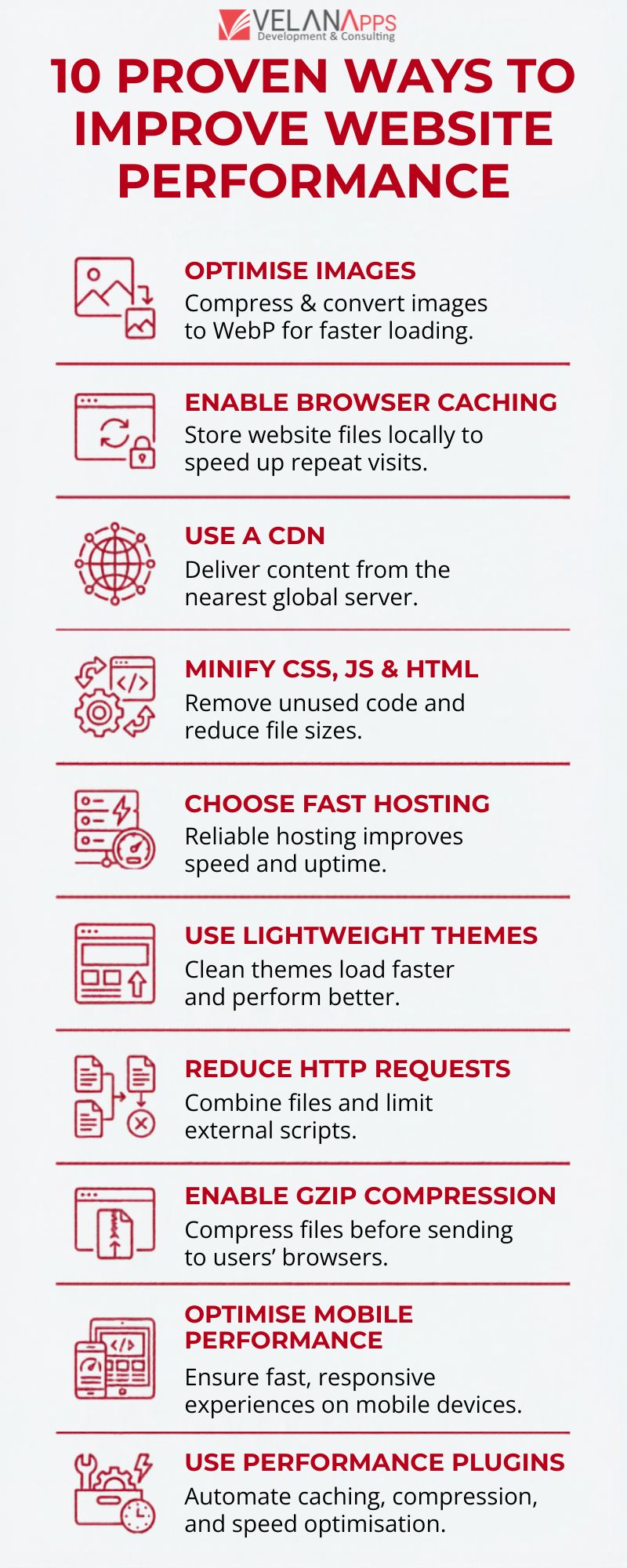
Optimise Images (WebP, compression tools)
High-resolution images may be a major obstacle for your website to load fast. Images can be compressed without losing quality to optimize images for website speed.
Enable Browser Caching
Browser caching stores files on your users’ computers so that when they return to the page, it loads much faster. This is a perfect showcase of some of the main browser caching benefits.
Implement a Content Delivery Network (CDN)
A CDN distributes your site globally on its servers so your pages load much faster no matter where your visitor accesses them from. We use a CDN for website speed to make it faster for everyone around the world.
Minify CSS, JavaScript & HTML
Trimkeeper / Unused code removal to reduce file size. minify CSS JS speeds up the loading time very well.
Choose Fast Hosting
Speed is also heavily dependent upon your hosting provider. Choosing the best hosting for fast websites ensures that they are always up and running without any faults.
Use Lightweight Themes (WordPress focus)
Your site will be a bit slower due to heavy elements. Select fast WordPress themes that are sleek & speedily coded.
Reduce HTTP Requests
Every single file request increases the load time. Fewer HTTP Requests — Mainly achieved by combining files and removing external scripts to reduce HTTP requests.
Enable GZIP Compression
GZIP simply compresses all files before sending them to the user’s browser, reducing the size of files and, consequently, improving load speed. This is important for GZIP compression website optimisation.
Optimise Mobile Performance
As mobile traffic dominates, the speed of mobile websites is the priority. Optimize heavy elements by using responsive design for mobile website speed optimisation.
Use Performance Plugins
Plugins are used to optimise functions like caching and compression. Famous WordPress speed plugins make performance enhancements easier.
Best Platforms for High-Performance Websites
1. WordPress (with optimisation)
With the right optimisations, WordPress is also very flexible and can be configured to perform extremely well. That makes it an excellent small business option.
2. Shopify
Shopify is a fast and easy-to-use platform with built-in performance features. It is perfect for e-commerce stores that need a decent performance without handling too much technical work.
3. Custom-built websites
With custom websites, you get complete control over both speed and features. They are a lot faster but require more technical knowledge and cost more.
The case will make the ideal website platform for a small business.
Top Website Speed Testing Tools
1. Google PageSpeed Insights
An easy way to see how fast your site is and what can be improved
2. GTmetrix
Gives you extensive reports and recommendations about your website speed, along with tips to improve your speed.
3. Lighthouse
A performance, accessibility, and SEO auditing tool in your browser.
These website speed test tools allow you to check website performance and troubleshoot problems faster than ever.
Common Website Performance Mistakes to Avoid
Using heavy themes
Huge designs slow down your site and detrimentally affect UX.
Too many plugins
Too many plugins slow down your page and create conflicts.
Unoptimised images
The major reason websites run slowly is improper images, specifically because they are large and uncompressed.
Poor hosting
Downtime and sluggish response time result from using cheap or unreliable hosting.
So, here are some website speed mistakes that knowing why the website is slow helps you avoid in order to fix it beforehand.
We help small businesses create fast, secure, and fully optimized websites designed to improve performance, SEO rankings, and customer experience.
High-Performance Website — Improving SEO & Sales
Better rankings
Faster websites rank higher on search engines and result in increased visibility and leads.
Higher engagement
Fast websites keep users engaged, resulting in longer sessions and lower bounce rates.
Improved conversions
Your website should be fast and smooth so users feel like taking some action, for example, making a purchase or filling out a form.
In addition to being the main factor of user experience, website speed is also one of the most important criteria for SEO: fast-loading sites rank higher and consequently produce more sales.
Website Performance Optimisation FAQs
What is a high-performance website?
An ideal-performing website is fast, SEO friendly, responsive, and user-experience-optimised across all devices.
How much time is needed for a website to load?
A website ideally has to load within 2–3 seconds. Under 2 seconds is even better for UX and SEO. Load times that are faster mean both lower bounce rates and greater engagement.
Does website speed affect Google ranking?
Yes, website speed is a known ranking factor. Core Web Vitals (also written as LCP, CLS, and INP) are ways Google uses to measure user experience. Websites that are faster tend to rank better in search results.
What are some quick tricks you use to increase your traffic?
- Compressing and optimising images
- Enabling browser caching
- By using a Content Delivery Network (CDN)
- Minifying CSS, JavaScript, and HTML
- Switching to faster hosting
What is the fastest platform for websites?
Each of these platforms has its unique advantages, and the best platform depends on what your needs are:
- WordPress, if properly optimized, has flexibility and strong performance.
- Shopify is perfect for managed eCommerce websites that need fast loading times.
- For the greatest speed control, opt for a custom-built site, but you need to be a coder.