 By
kingsly jebaraj
By
kingsly jebaraj A small internal team will find it hard to manage multiple WordPress projects as the agency expands and reaches the point of growing. Recruiting developers is a time-taking procedure, the cost of operations increases, and it becomes difficult to keep up with project deadlines.
This is why many agencies use white-label WordPress development. It allows agencies to outsource technical WordPress work to experienced developers while keeping their own branding and client relationships.
What Does White Label WordPress Development Mean for Agencies?
White label WordPress development refers to outsourcing the building or management of WordPress websites to an external team but under your agency brand name. You can involve your client directly with you as an agency, and the outsourced team takes care of the tech work from behind the scenes. It is a model that allows agencies to expand services without having a full internal development staff.
How It Works in Real Projects
In most projects, the agency manages sales, communication, and strategy. The white label team handles the following:
- WordPress website development
- WooCommerce setup
- Theme customisation
- Plugin integration
- Website maintenance
- Bug fixes and updates
The client only sees the agency brand throughout the project.
Who Typically Uses this Model?
Common users of white label development for agencies include:
- Digital marketing agencies
- SEO agencies
- Web design studios
- Branding firms
- Freelancers managing multiple clients
Is White Label WordPress the Right Fit for Your Agency?
Not every agency needs outsourcing. However, it works well in certain situations.
Situations Where It Works Best
White label partnerships are useful when the following are true:
- Project demand is increasing.
- Hiring developers is difficult.
- Delivery timelines are tight.
- Agencies want to reduce fixed costs.
- Specialized WordPress expertise is needed.
Overburdened agencies should consider outsourcing as a method of increasing efficiency and scalability.
When Not to Use It
White label suitability may be limited if:
- Your agency has a good in-house staff.
- Projects require constant in-person collaboration.
- Internal workflows are not organised.
- You do not have project management processes in place.
Why Scaling WordPress Projects Internally Becomes a Bottleneck
Many agencies try to grow using only internal teams. Over time, this creates operational challenges.
Delays in Hiring Skilled Developers
Locating seasoned WordPress developers can require weeks or months. Agencies also spend money on recruiting, onboarding and training people. Increasing Operational Costs
Increasing Operational Costs
Internal development teams require:
- Salaries
- Benefits
- Software tools
- Office space
- Equipment
These costs continue even during slower business periods.
Missed Deadlines and Project Overload
As the number of projects increases, it can be difficult to keep teams on track. In this post, we looked at some of the most common causes of churn in WordPress development: delayed launches, quality issues and unhappy clients.
White-Label Partnerships: Breaking Growth Barriers
White label development helps agencies scale faster without large investments.
Capacity on Demand Development
This means that you can expand or shrink development resources depending on workload.
Faster Client Delivery Cycles
Over the course of their work, seasoned WordPress teams tend to have structured workflows already in place, which in turn speeds project completion for agencies and increases client satisfaction.
Missed Deadlines and Project Overload
As the number of projects increases, it can be difficult to keep teams on track. In this post, we looked at some of the most common causes of churn in WordPress development, delayed launches, quality issues and unhappy clients.
White-Label Partnerships: Breaking Growth Barriers
White label development helps agencies scale faster without large investments.
Capacity on Demand Development
This means that you can expand or shrink development resources depending on workload.
Faster Client Delivery Cycles
Over the course of their work, seasoned WordPress teams tend to have structured workflows already in place, which in turn speeds project completion for agencies and increases client satisfaction.
How Much Does White Label Management Cost?
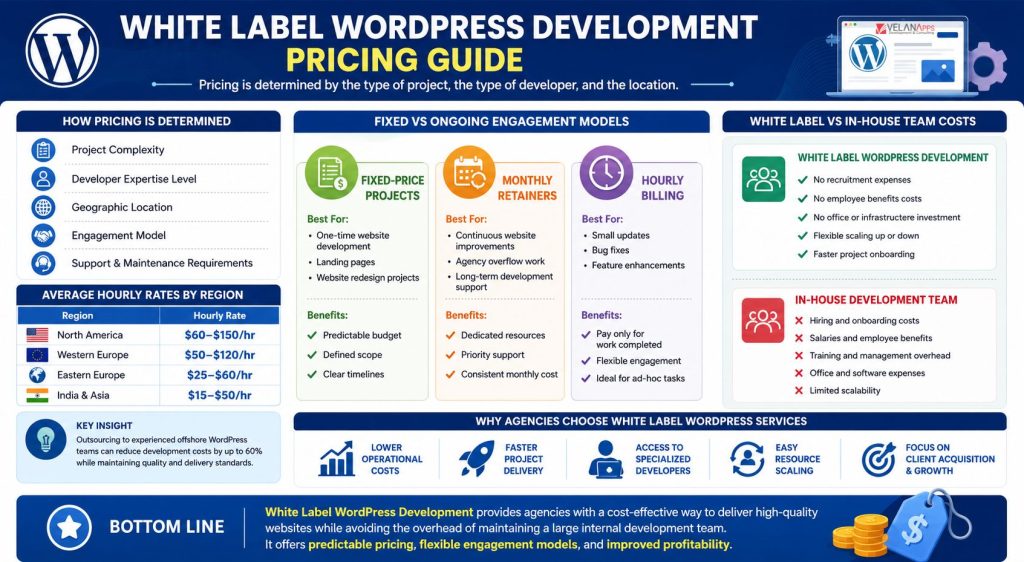
Pricing is determined by the type of project, the type of developer, and the location.
Average Hourly Rates per Region
| Region | Hourly Rate |
| North America | $60–$150 |
| Western Europe | $50–$120 |
| Eastern Europe | $25–$60 |
| India & Asia | $15–$50 |
These are common white-label WordPress pricing estimates.
Fixed vs Ongoing Engagement Models
| Model | Best For |
| Fixed-price projects | One-time websites |
| Monthly retainers | Ongoing support |
| Hourly billing | Small updates |
Cost Comparison with In-House Teams
White label partnerships usually reduce costs related to recruitment, infrastructure, and employee benefits. For many agencies, outsourcing WordPress cost structures is easier to manage than maintaining large internal teams.
White Label vs. Freelancers vs. Internal Teams
Often, agencies will look at different development models before making a decision.
Cost Effectiveness
Freelancers can be a practical and lower-cost option for lower-volume work, but white-label agencies deliver much more value and reliability for long-term work. Scalability and Flexibility
Scalability and Flexibility
White label teams can quickly scale resources based on project demand, unlike most in-house teams.
Quality and Accountability
White-label providers generally offer more of the following than freelancers: Dedicated project managers, Quality assurance processes
- Dedicated project managers
- Quality assurance processes
- Structured workflows
- Better communication systems
How to Pick a Trustworthy WordPress White Label Partner
The success of the project depends on selecting the proper partner.
Evaluating Technical Proficiency
Before you hire white-label WordPress developers, review their:
- WordPress experience
- WooCommerce knowledge
- Plugin customisation skills
- Security practices
Reviewing Past Work and Case Results
Ask for:
- Portfolio samples
- Client reviews
- Case studies
This helps evaluate their experience and reliability.
Starting With a Trial Engagement
Begin with a small project to test communication, quality, and delivery speed.
Setting Communication and Delivery Standards
Clear processes help agencies choose outsourcing partner relationships more effectively. Define timelines, reporting schedules, and revision systems early.
How White Label Development Impacts Agency Profitability
White label partnerships can improve business performance over time.
Lowering Costs
By teaming up with fresh outsourcers, agencies can save a lot of money on labor, onboarding, salaries, and even rent.
Increasing Project Volume
Additional development support allows agencies to handle more projects without expanding internal staff.
Improving Margins Over Time
Faster delivery and lower operational costs contribute to agency profit margin improvement and stronger outsourcing ROI.
Common Challenges in White Label Development and How to Handle Them
Like any outsourcing model, white-label development has challenges.
Communication Gaps Across Teams
Remote collaboration may create misunderstandings about project requirements or revisions.
Maintaining Consistent Quality
Quality can vary if processes are not clearly defined.
Managing Deadlines and Expectations
Being spread out across different time zones and a change in project scope can delay deliveries.
How to Mitigate These Risks
There are various ways that agencies can mitigate the risks from outsourcing.
Agencies can reduce outsourcing risks by:
- Using project management tools
- Holding regular meetings
- Creating clear documentation
- Setting quality standards
- Starting with smaller projects first
These steps help minimize common white-label challenges.
Example: Scaling an Agency Using White-Label WordPress Support
A digital agency was suffering from slow delivery of new websites, resulting in unhappy clients and staff. Instead of hiring a large in-house team to do their services, the agency decided to go with a white-label WordPress provider.
The agency communicated with clients and sold, while the outsourced team worked on development and maintenance.
The agency ramped up delivery speed, lowered operational costs and increased the monthly project capacity within months. This project is a common white-label case study and agency growth example.
Tools supporting Smooth White Label Collaboration
Popular development workflow tools and WordPress collaboration tools include:
- Slack and Microsoft Teams for communication
- Trello and Asana for project management
- GitHub for code management
- Figma for design collaboration
These tools enhance transparency and enhance workflow efficiency.
Why Many Agencies Choose Offshore Teams for White Label Work
Many companies hire WordPress teams in other countries because they are cheaper and can be easily scaled up or down.
Some of the well-known outsourcing locations are:
- India
- Philippines
- Eastern Europe
- Vietnam
Offshore teams are popular with agencies, as they offer well-qualified developers at a decent price and allow for faster scaling of projects.
FAQs
What is white-label WordPress development?
This is a setup where agencies hand over their WordPress development work to offshore teams, which operate under the agency’s brand.
How much does it usually cost?
Depending on your location and experience, the hourly rates vary between $15 and $150.
Is this model secure for client projects?
Professional providers use NDAs, secured platforms, and confidentiality agreements.
How do agencies manage external teams?
Besides communication tools and project management software, agencies also rely on folders and set workflows to keep track of their work.
How do white labelling and outsourcing differ?
It is not uncommon for white-labelling partnerships to have the agency in full control of branding and the client through the external team, which only supports them “behind the scenes” without having their own direct contact with the client.